







TL:DR
- Sentiment analysis looks at how traders are positioned in the market and can provide insight into overall crowd psychology.
- These tools are often used as contrarian indicators, meaning that when most traders are heavily buying, prices may actually be more likely to fall, and vice versa.
- Unlike technical analysis, which focuses on charts, and fundamental analysis, which focuses on economic data, sentiment analysis shows how traders are currently positioned in the market.
- Popular sentiment tools include the Commitment of Traders (COT) report, broker sentiment indicators, and the Speculative Sentiment Index (SSI), each offering a different view of market positioning.
- Sentiment analysis works best when combined with technical and fundamental analysis, helping traders confirm trends, spot potential reversals, and avoid crowded trades.
We all know about technical and fundamental analysis in forex, but what is sentiment analysis? Although a rarely used trading approach, it is beneficial for observing crowd psychology, which ultimately affects price fluctuations.
Sentiment analysis refers to gauging how a large group of market participants feel (hence ‘sentiment’) about the direction of a market.
The interesting question then becomes, how do we measure market sentiment to make informed trading decisions? There are two methods in forex. The first is sentiment indicators from a few prominent forex brokers.
The second method is the Commitment of Traders. This report is a weekly publication by the Commodity Futures Trading Commission (CFTC). The data in the report is based on financial markets such as commodities, energy, metals, indices, and, of course, forex.
In either case, sentiment data is a subtly powerful way to see how a considerable number of traders are positioned.
Why are sentiment tools contrarian indicators?
The most important thing about nearly all sentiment tools is their contrarian nature. Market trends are necessary for moving prices up and down, and trading on their side (‘the trend is your friend’) is ‘trading 101’. Sentiment data often proves that retail traders go against the trend by continually looking for reversals.
This camp boasts tiny trading volumes to have any significant impact on market movements, even when a reversal might seem lucrative. On the other hand, institutional traders (or the ‘smart money’) have power in numbers and are the catalysts for all big moves in the long haul.
The notion is that they go against the 'dumb money' or the retail traders. For example, if the overall sentiment data reflects that 80% of traders are long, this should be taken as a bearish signal (and vice versa for 'short'). We believe that the institutional traders have the power to impose an opposite effect on price movements.
Another interesting aspect is how retail traders buy at tops or sell at bottoms. Essentially, it's when many investors buy when the price has gone too high or sell when it is too low. There’s a perception that very few people are left to keep driving the market higher or lower, meaning the price can only go in the opposite direction.
This phenomenon is one that institutional traders are cited as exploiting, and one that, with the right knowledge, we can also capitalize on.
How is sentiment analysis different from technical and fundamental analysis?
Most traders would agree that technicals ‘set the prices to enter, while fundamentals move those prices. But what about sentiment? Such a question can be quite tricky to answer confidently.
Sentiment may be the factor that reflects a mismatch between technicals and fundamentals. Let us illustrate with an example.
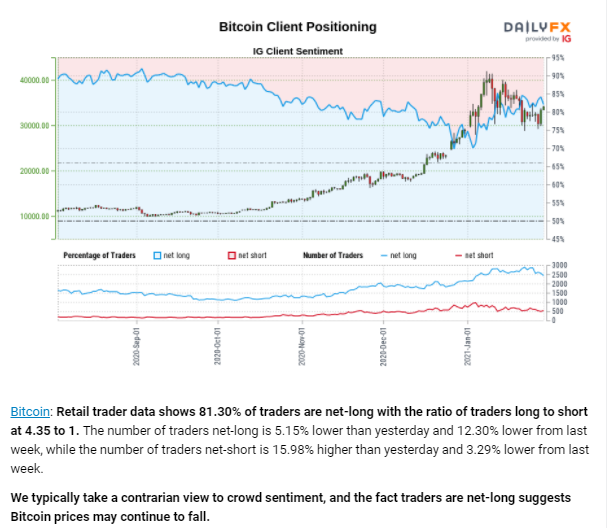
The image above is the IG Client Sentiment report for Bitcoin or BTC/USD in 2021. While not an exclusive forex pair, Bitcoin's main price is against the US dollar, and we can use this as a good case study.
The technical analysis clearly showed a strong bull market. Also, during this time, the fundamentals suggested a weak dollar and higher Bitcoin adoption than ever before. Using these attributes, the immediate bias anyone would have is to go long.
However, there was a mismatch between these facts and the sentiment data. An overwhelming number of clients were net long or held buy orders (81.30%), naturally implying that prices would continue to rise.
As we’ve established, sentiment is often a contrarian indicator, so IG suggested prices may fall instead. The mismatch is that, although the technical and fundamental analyses generally agreed on a bullish bias, the market felt different.
This idea reinforces the previous concept of retail traders buying at very high prices (or selling at very low prices).
The main downside of sentiment analysis in forex
Some may argue that sentiment is more important than technical or fundamental analysis because an indicator like the IG Client Sentiment report captures the true feelings of market participants.
The reasons for them holding the positions they have may have little to do with some economic report or resistance level. Thus, technical and fundamental analysis might seem insignificant if we can see how the market is feeling.
However, as with anything, sentiment changes at the drop of a hat as millions of traders switch positions for other reasons. How most investors feel right now does not accurately reflect how they’ll feel in the next few hours or even a few minutes.
Unfortunately, forex is a decentralized market. This means very few, if any, have access to the orders of every single one of the millions of traders, let alone a vast majority of them. For example, IG claims to have at least 313,000 clients, which is minuscule compared to the broader market.
Which are the best forex market sentiment indicators?
There are very few viable sentiment market indicators that are relevant to FX. As already established, forex is an over-the-counter market where an ordinary person would not have access to the actual trading volume for a particular pair. Essentially, there is no one central ‘forex order book.’
Although some analysts may reference tools like the CBOE Volatility Index and the Fear and Greed Index, these are far less relevant to FX price movements.
Thankfully, there are several indicators worth exploring for sentiment in forex, which traders have trusted for years.
- Commitment of Traders (COT): The CoT is the closest report to finding out the positions of smart money or the ‘big boys' in forex. The CFTC publishes the CoT every Friday.It reports the positions of currency futures market traders (a significant portion of whom are institutional traders) on the Chicago Mercantile Exchange, the world's largest futures exchange. The forex futures markets move in tandem with the spot forex markets we trade, making the CoT a precious tool for long-term trends in the latter.
Still, the report only comes out weekly. Therefore, it may be lagging by the time you see it. Also, the report doesn’t show positioning data for pairs but for individual currencies, meaning you need to compare two sets of information, leaving room for unwanted interpretation.
- Broker sentiment indicators: These tools are offered by a handful of forex brokers, including IG, Oanda, Axi, FXCM, FIBO Group, Instaforex, and Dukascopy. These are typically numerical and graphical, showing client positioning data for specific markets based on percentages of how many people are going long or short.
Some may also provide the directional bias (bullish, bearish, or mixed) that traders should consider. Broker-provided sentiment market indicators usually update every few minutes.
- Speculative Sentiment Index by FXSSI: This tool partly solves the problem of relying on a sentiment indicator aggregating from a single broker. The companies covered here include Oanda, Ducaksopy, IG Group, Fibo Group, and Instaforex, along with positioning taken from users on Forex Factory, FX Blue, Myfxbook, and FXSSI. Not only does it show the ratio of buy and sell positions, but it also indicates the ideal signal in arrow form (so a downwards red arrow for bearish, an upwards green arrow for bullish market; a flat grey arrow for neutral.
Other features of this tool include weighted average values, customizable sorting options, and sentiment charts. Still, one disadvantage of the SSI is its limited market range. Currently, it covers AUD/JPY, AUD/USD, EUR/AUD, EUR/JPY, EUR/USD, GBP/JPY, GBP/USD, NZD/USD, USD/CAD, USD/CHF, USD/JPY, and XAU/USD.
How to use market sentiment data in forex
One of the things sentiment analysis can do is confirm a trend. Although you can identify the predominant trading direction to trade with either technicals or fundamentals, sentiment analysis can be an extra supporting factor.
A tried-and-tested way of truly confirming a trend is looking for ‘extremes’ between net-long and net-short orders. In other words, you want an overwhelming percentage of buyers/sellers against sellers/buyers, at least 50% but preferably above 70%; the wider the gap, the better.
Let’s consider recent EURCHF client positioning from IG’s client sentiment report. In the image below, we have drawn two arrows to show the negative correlation between the increase in net-long positions and the continuously declining prices.
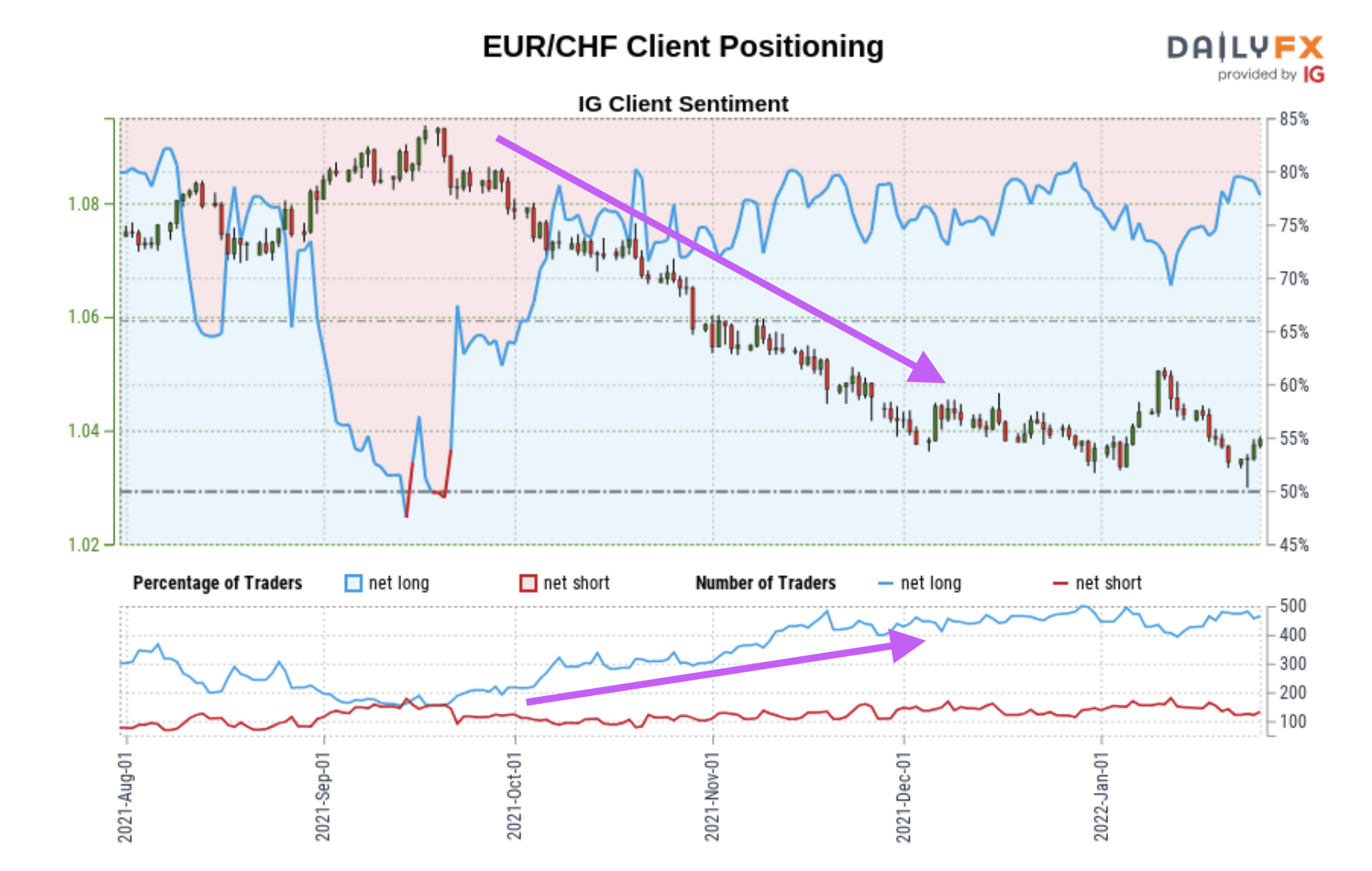
As sentiment is typically a contrarian indicator, the price kept falling even as more and more people had long orders. Likewise, sentiment analysis could help show you early trend changes by gradually observing an increase in orders on one side versus the other.
Another method is to use sentiment analysis to identify any mismatches in your technical or fundamental analysis. For instance, if your results indicate a selling or buying opportunity for a particular pair, but sentiment data suggests otherwise, you may pass on this setup or consider it unreliable.
Conclusion
At its core, sentiment analysis adds another layer to our understanding of the market. While technicals help you time entries, fundamentals explain broader moves, and sentiment reveals how other traders are actually positioned. This tells you what to do directly and the 'market mood' of the crowd.
Another takeaway is that sentiment often works best as a contrarian tool. When the majority of traders are heavily positioned in one direction, it can signal that the move is already stretched, leaving little room for further continuation. This is where institutions, with greater capital and influence, can step in and drive prices the other way.
However, tracking sentiment isn’t perfect. It can shift quickly, and no single tool captures the full picture of a decentralized market like forex. That’s why it shouldn’t replace technical or fundamental analysis; rather, it should complement them. Used correctly, it helps you spot mismatches, confirm trends, and avoid crowded trades.
