





TL:DR
- Fundamentals-focused trading relies on tools such as economic calendars, news squawks, interest rate trackers, risk sentiment indicators, and the Commitment of Traders (COT) report to better understand market conditions and expectations.
- Economic calendars and news squawks help traders stay up to date on major data releases, central bank decisions, and breaking developments that can drive volatility.
- Interest rate trackers and risk sentiment tools help traders understand market expectations, capital flows, and whether markets are leaning toward risk-on or risk-off behaviour.
- Additional tools like charting platforms, market scanners, and risk management calculators improve execution, trade analysis, and consistency over time.
- No single tool guarantees success; the real edge comes from combining the right tools.
In a market as complex and interconnected as forex, having the right trading tools is no longer an option. Unlike purely technical approaches that rely heavily on charts and indicators, a fundamentals-based trading style requires a broader view of the financial markets.
You have to explore specific tools like economic calendars, interest rate trackers, and sentiment indicators, including risk sentiment indicators, to make highly informed decisions.
Below are some of the most valuable trading tools (both free and paid) that can support a fundamentals-focused trading strategy, whether you’re a beginner or among more experienced traders.
1. Economic Calendar
An economic calendar tracks key data releases such as inflation, GDP, employment figures, and central bank decisions in real time. These events often drive volatility and create the conditions or offer the catalyst for strong trade ideas.
Economic calendars help you prepare for and provide context behind certain price movements, especially those caused by high-impact releases. They are particularly useful for news traders who closely monitor forecasted data and have pending orders in the anticipated direction.
Premium economic calendars, such as the one from the Financial Source, go beyond standard features. Instead of just a median estimate, they include a high and low forecast range, showing the full spread of analyst expectations.
This is important because markets tend to react most when data comes outside that range, signalling a true surprise. The median alone doesn’t show how significant a deviation really is.
These calendars also highlight these surprises instantly and provide insights into which currencies may be most affected. This gives traders faster context and a clearer understanding of market-moving events.
2. News Feeds/Squawks
Real-time market news is freely available online from traditional business media platforms like Reuters to forex-focused analysis sites like FXStreet. It provides ongoing economic updates, breaking headlines and geopolitical developments in currencies. Short-term retail traders benefit the most as being updated in this regard supports faster decision-making.
An audio or news squawk is a real-time stream of market-moving information delivered via voice, allowing traders to stay up to date without constantly scanning headlines. Instead of reading through multiple sources, you hear key developments as they happen, which is especially valuable in a dynamic market like forex.
When breaking news hits, whether it’s a central bank comment, geopolitical headline, or unexpected data release, you’re alerted immediately. During major economic events, a squawk adds instant context, helping you understand whether the outcome is stronger or weaker than expected.
It’s also particularly useful during central bank speeches, where markets can shift based on subtle changes in tone. A squawk highlights important phrases and shifts in messaging in real time, allowing you to stay aligned with the broader macro narrative as it develops.
Another key benefit is filtering. Not all news matters, and a good squawk focuses only on information that is relevant to the market. This helps reduce noise and keeps your attention on developments that are likely to drive price action.
For more active traders, especially during volatile sessions, a squawk provides valuable context behind sudden moves. It can help explain why the price is reacting the way it is, reducing the likelihood of trading blindly. While it won’t give you direct trade signals, it plays a notable role in keeping you informed, improving your timing, and staying in sync with impactful market data.
3. Interest Rate Tracker
Interest rate trackers help you see what the market expects central banks to do next, not just what they’ve already done. They translate market pricing into probabilities for rate hikes, cuts, or holds, giving you a clearer view of the current baseline. This is crucial because currencies often move in line with interest rate expectations. By tracking these changes, traders can better anticipate reactions and align their analysis with where the market is leaning.
Free interest rate trackers show a list of current interest rates for major central banks, along with the dates of upcoming data releases. However, you would still need to consult an economic calendar to view the forecast to prepare yourself.
Meanwhile, premium interest rate trackers from the likes of Financial Source are more advanced, showing the most likely outcomes, implied points, and more.
4. Risk Sentiment Tool
Forex is heavily influenced by global sentiment. Is the market in risk-on mode, chasing returns? Or risk-off, seeking safety? Risk sentiment tools help answer these questions in real time, helping you understand whether markets are leaning toward risk-taking or risk aversion. They track how assets like equities, safe-haven currencies, and commodities are behaving to give a read on the overall market mood.
This matters because currencies often move in groups depending on sentiment, not just individual data releases. By monitoring these shifts, traders can align with broader market flows rather than trading in isolation.
Sadly, forex-specific trading tools in risk sentiment are quite limited currently. The only exception is Babypips' Risk On, Risk Off Meter. It's really well-designed, easy to use, and, most importantly, updates with real time data.
5. Commitment of Traders Report
The Commitment of Traders (COT) report shows how different large speculators are positioned in forex futures contracts, which run parallel to the spot market.
It provides insight into whether these participants are heavily long or short a currency, helping you understand broader market bias. While not used for precise entries (and is delayed by three days from the day of its release), it’s valuable for confirming trends and potential reversals.
There are plenty of free visualisation tools for the Commitment of Traders report online, along with indicators on trading platforms like TradingView.
The trick is to find one that is the easiest to read, as it does take some time to understand how the report truly works.
Other Trading Tools to Consider
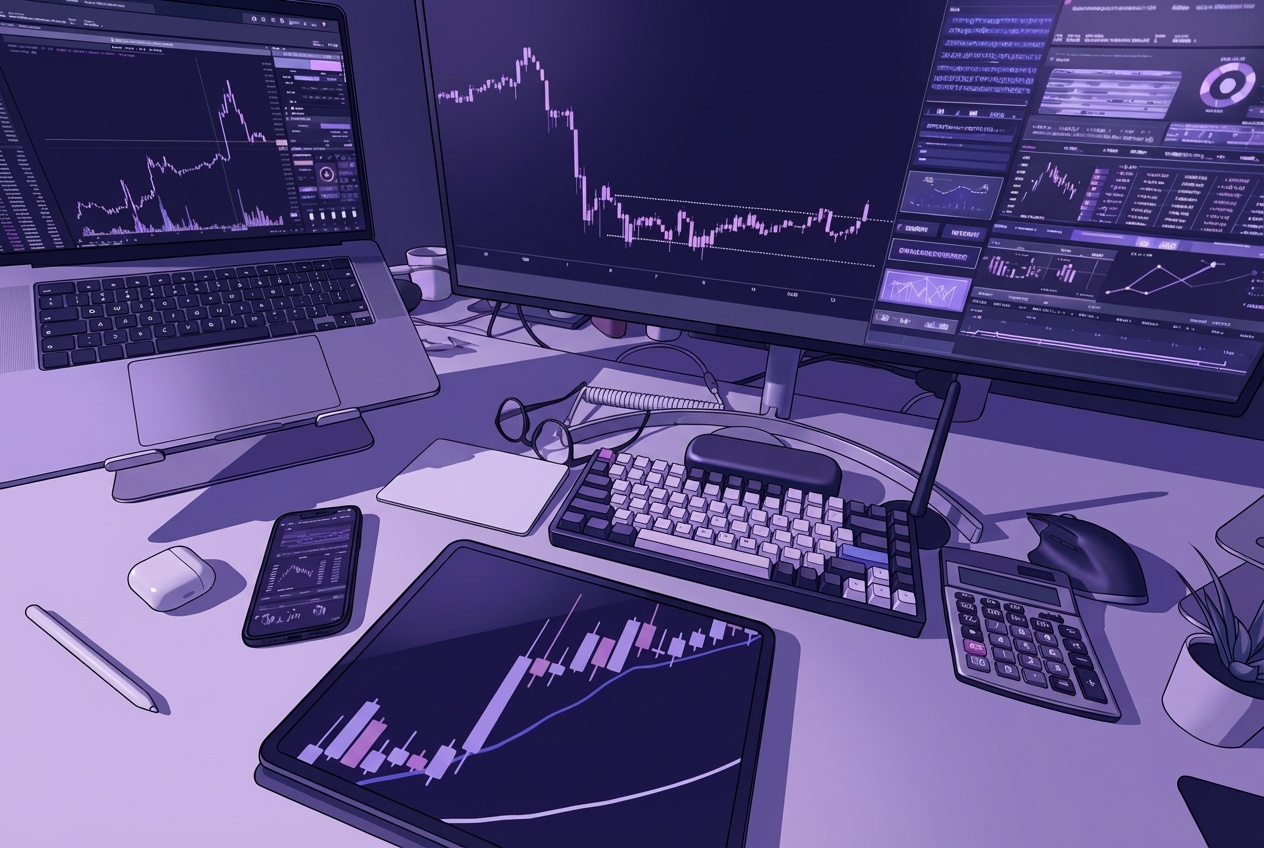
Beyond the core trading tools covered earlier, several additional resources can quietly elevate your overall workflow. These aren’t always seen as essential at first, but over time they become part of how you refine execution, improve consistency, and better interpret the market:
- Charting platforms sit at the intersection of fundamentals and execution. Even if your approach is macro-driven, you still need a way to translate ideas into actual trades. Trading platforms like TradingView, cTrader and MetaTrader 4/5 allow you to visualise price, apply technical analysis tools, and set price alerts so you’re not glued to the screen. They help bridge the gap between understanding the why and acting on the when.
- Risk management trading tools play a critical role in protecting your capital. Simple tools like risk calculators and position sizing calculators ensure that no single idea can significantly damage your account. In a market where uncertainty is constant, managing downside risk is just as important as identifying opportunity.
- Market scanners and screeners add another layer of efficiency. Instead of manually searching for opportunities, these trading tools highlight potential setups across multiple markets. Whether it’s identifying relative strength, spotting volume spikes, or filtering for specific conditions, they help streamline the process of generating trade ideas.
Finally, many experienced traders begin to build their own workflows using a mix of these specialized tools. This might include combining economic market data, sentiment indicators, charts, and news into a single view. Some go a step further, using software or automated systems to organise information and reduce noise. The goal is to create an environment or setup that allows you to process information quickly and stay aligned with the market.
Final Thoughts
There is no single tool that guarantees profit. The edge comes from how you combine them. At its core, successful trading in forex is about:
- Understanding expectations
- Interpreting market data
- Managing risk
- Executing with discipline
The tools listed above are part of the infrastructure that supports better investing decisions. Because in the end, the goal isn’t to use more tools; it’s to use the right ones to make smarter, more confident decisions in a constantly evolving market.
