





TL:DR
- Currency pairs often move together or in opposite directions, which helps us understand what is happening in the forex market.
- Correlations can prevent traders from taking multiple trades with a very similar directional bias, improving overall risk management.
- Traders can also use correlations to hedge positions or identify potential opportunities when related currency pairs have not yet made a similar move.
- Some currency pairs have historically strong relationships, such as EUR/USD and USD/CHF moving in opposite directions, or many JPY pairs moving in the same direction.
- Correlations are useful but not permanent. They can change over time, especially during periods of high volatility. So, they should be used as a supporting tool rather than being relied upon solely.
In forex trading, one of the beautiful advantages is how traders analyze pairs rather than standalone markets. So, for instance, if we are trading cable, there are two entities to observe at any given moment: the British pound and the US dollar.
When one part of the quote becomes weaker, the other should gain strength, and vice versa. Such correlations are in constant motion in the forex market on all time frames. Any trader wishing to enhance their understanding of the markets constantly analyzes these strengths and weaknesses across multiple markets.
Currency correlation helps us forecast potential moves, ensures we don’t increase risk unnecessarily, and, for some, can also be used for hedging purposes.
What is correlation?
Correlations are the measure of a statistical relationship between two currency pairs. When different currency pairs generally move in the same direction, we refer to this as a positive correlation or positively correlated markets. Conversely, when pairs are usually travelling in opposite directions, we refer to this as a negative/inverse correlation or negatively/inversely correlated markets.
When two markets do not typically move in the same or inverse direction, there is no correlation. It’s crucial to appreciate correlation by considering direction rather than magnitude. For example, multiple currency pairs may share a positive relationship.
However, one might move 50 pips while the other moves 100 because of their volatility. On a more technical level, several charts actively track correlations across many markets using coefficients.
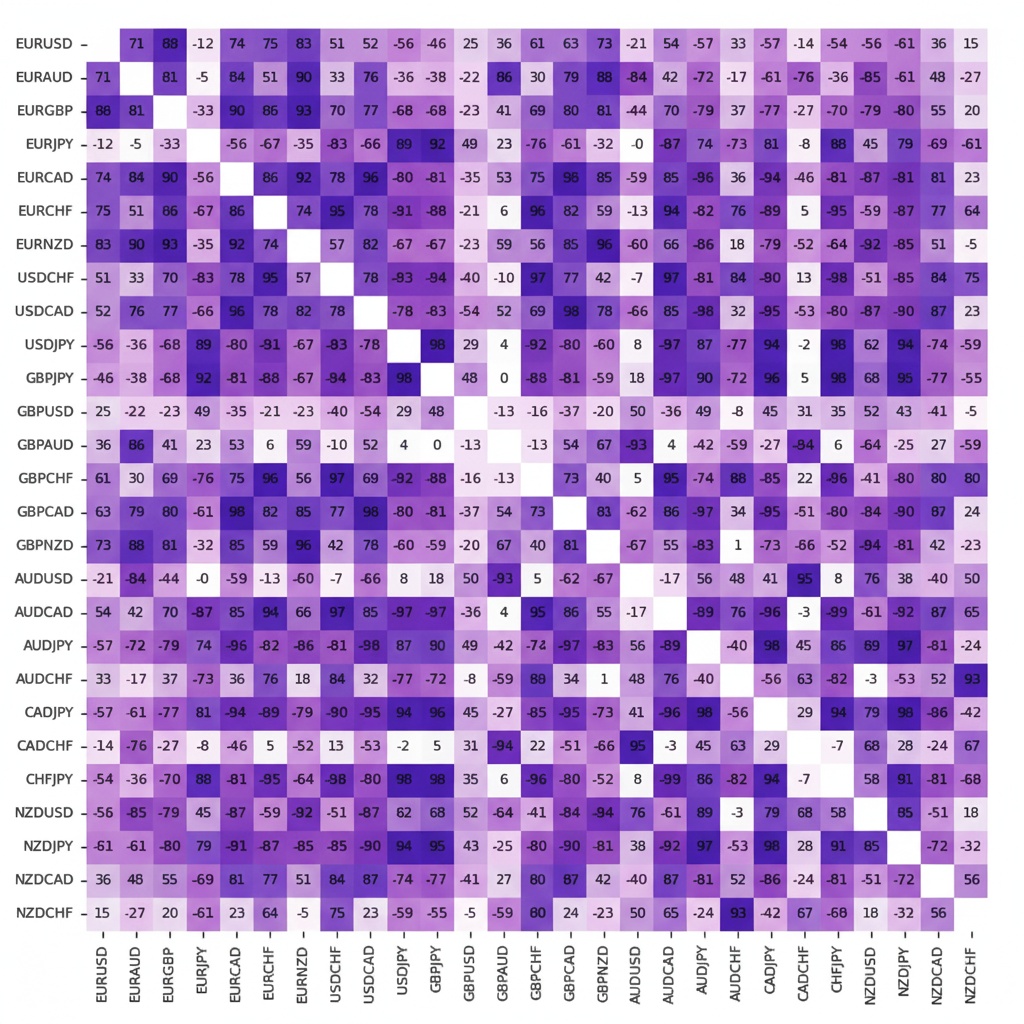
A correlation coefficient measures the relationship using values ranging from -100% to 100% or -1 to 1. For instance, markets with strong positive correlation should have a coefficient closer to 100% or 1, and vice versa for currency pairs with strong negative correlation.
Analysts consider markets with a correlation above or below 70 to be highly correlated pairs that traders should pay close attention to. A correlation chart will show these relationships across a range of forex markets and how they behave on all commonly used time frames.
Fortunately, several markets historically share a consistently strong link without needing to know their coefficients. For example, the almost perfect negative correlation between USD CHF and EUR USD is well-known because of the relationship between Europe and America.
Other pairs exhibiting historically strong correlations also include:
- AUD/USD, NZD/USD, EUR/USD, and GBP/USD often exhibit price movements opposite to USD/CAD and USD/CHF because USD is the base or quote currency.
- Yen-based cross/minor pairs (AUD/JPY, CAD/JPY, EUR/JPY, GBP/JPY, NZD/JPY, USD/JPY) exhibit a more or less perfect positive correlation because the Japanese yen is the quote currency.
It’s crucial to note that the correlations above are only for the major and minor pairs. Many exotics with the Australian dollar, Canadian dollar, New Zealand dollar, Swiss franc, Euro, Japanese yen, and US dollar as part of their quote will typically exhibit a noticeable connection when compared with their counterparts.
How can correlations help forex traders?
Correlations can aid traders in several ways.
Risk management
Perhaps the most vital benefit is risk management. Although we have access to tens of markets through our brokers, we should focus on a handful at any given time, as most will move in two directions.
For instance, if one sees a buying opportunity on EUR/USD and a selling opportunity on USD/CNH, these instruments generally move in opposite directions because of the dollar. By taking these trades, the trader unnecessarily increases their position-sizing risk.
If both markets moved against them simultaneously, these opposing positions would likely have running losses. Correlations emphasize why over-trading is generally a bad idea and that traders only need to focus on a handful of pairs.
Hedging
Traders can use forex correlations for hedging purposes. If we refer back to our previous example of EUR/USD and USD/CNH, a trader could instead buy EUR/USD and buy USD/CNH as a hedge. If their original EUR/USD went against them, the gains on USD/CNH should offset their losses.
Forecasting potential moves
Lastly, knowing correlations can help traders forecast potential moves in other trading opportunities. A correlation doesn’t offer a minute-by-minute relationship between different pairs, only the direction.
Let’s imagine we saw AUD/JPY break a low while analyzing EUR/JPY. We could see the latter not moving at all, while the former may continue making new lows. The probability is high that EUR/JPY should eventually make a downward movement, even if it didn’t necessarily move simultaneously with AUD/JPY.
Mistakes to avoid with correlations in forex
Perhaps the biggest mistake to avoid with correlations is assuming they always remain constant. Sadly, they will sometimes change depending on several factors, one of which is the period reference.
For instance, EUR/USD and USD/CHF do exhibit reliably similar inverse market movements. However, different time frames may show opposite movements depending on EUR, USD, and CHF.
Understanding this attribute is especially crucial for hedging because there is never a guarantee that correlation will completely offset a loss. Therefore, traders should always split their risk in half when performing hedged trades rather than allocating the same portion of their account as they typically would with a single order.
Generally, correlations remain more consistent in the long term. Shorter time frames can exhibit unusually high volatility, with markets moving out of correlation more easily.
Final word
One of the most significant advantages of forex from a technical standpoint is the power of currency pair correlations. Since we express currencies in pairs, we can identify discrepancies in the relative strength or weakness of one currency versus another.
Unlike more individual instruments like commodities, we can better understand what moves a pair overall by comparing its complement. Correlations also help tremendously in not doubling up on risk.
As with anything in forex, it’s not foolproof. Thus, it should not be something traders rely upon solely.
