






TL:DR
- Trading is a game of probabilities, not certainties.
- Losing streaks are normal and can happen at any time, which is why strong money management is essential to survive long enough.
- Recency bias can mislead traders into expecting recent outcomes to repeat, even though each trade is independent.
- The law of large numbers shows that results even out over many trades, making long-term performance more important than short-term outcomes.
- Winning percentage alone doesn’t determine success. Profitability depends more on risk management, consistency, and risk-to-reward over time.
Trading any financial market is a game of probabilities and NOT certainties. Even the smartest mathematicians understand this one fact that seems to elude struggling traders. Fortunately, the probabilities of trading are simple to understand.
The best and most commonly used analogy for understanding probabilities in trading is the coin toss. It shares one key element with the financial markets: dual outcomes. At any given instant, the price can only travel in two directions, up or down. In a coin toss, no matter how many times you flip the coin, it will either land on heads or tails.
The next question is: if we were to bet, for example, $10 that the coin will land on heads on every occasion, how long would we still have enough ‘betting money’ before the coin eventually lands on heads? In a nutshell, the same principle of money management in trading applies; you need to have enough money to keep ‘flipping the coin’ until it lands on heads.
The reality is that even though there is mathematically a 50% chance of either outcome, we cannot know with firm conviction exactly when it will land on heads. It could be after the first or the 20th flip.
We could have a winning streak of six heads or a losing streak of six tails in a row. The permutations are random. This analogy is probably the best way to think about the probabilities here and the complex reality of trading.
Probabilities of losing streaks
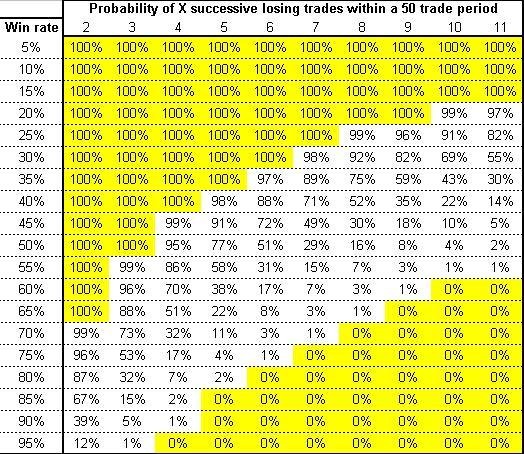
Probabilities matter more in managing losing streaks than in any other area. Losses are often undervalued even by the most confident traders. It’s natural to assume with a high amount of confidence that a trade is a sure winner without much thought that perhaps the next two or three in a row can lose.
The image above is a typical mathematical model that traders can use to better understand the likelihood of a losing streak over 50 trades. We must bear in mind that a losing streak can occur at any stage, regardless of trade frequency. Even for a trader who may trade twice a month, the probabilities of a losing streak are possible, albeit they would happen over a very long period.
How recency bias negatively affects traders
Many psychological scholars assert that, cognitively, we tend to estimate the probability of something happening less on a long-term basis and more based on what occurred recently. Recency bias is the tendency to favour recent events and assume they will play out similarly in the future.
For example, it’s pervasive to believe that a winning trade that traveled a substantial 200 pips will also occur on the next one. Since this is a recent event, the brain will almost trick the trader into acting the same way they did recently.
However, in reality, due to the market’s randomness, that event has a 50-50 probability of occurring as established. In fact, the likelihood is that the trader may lose the next trade or that the market may not travel 200 pips.
The outcome of any trade is uncertain, and each outcome is independent of future ones.
Why you must understand the law of large numbers
This law provides the perfect explanation of the relationship between winning percentages and probabilities. The law of large numbers dictates that as the sample size of a series of outcomes expands, it gets closer to its average.
We can define the average outcome in any financial market as 50%. Again, the perfect example for understanding probabilities here is a coin toss.
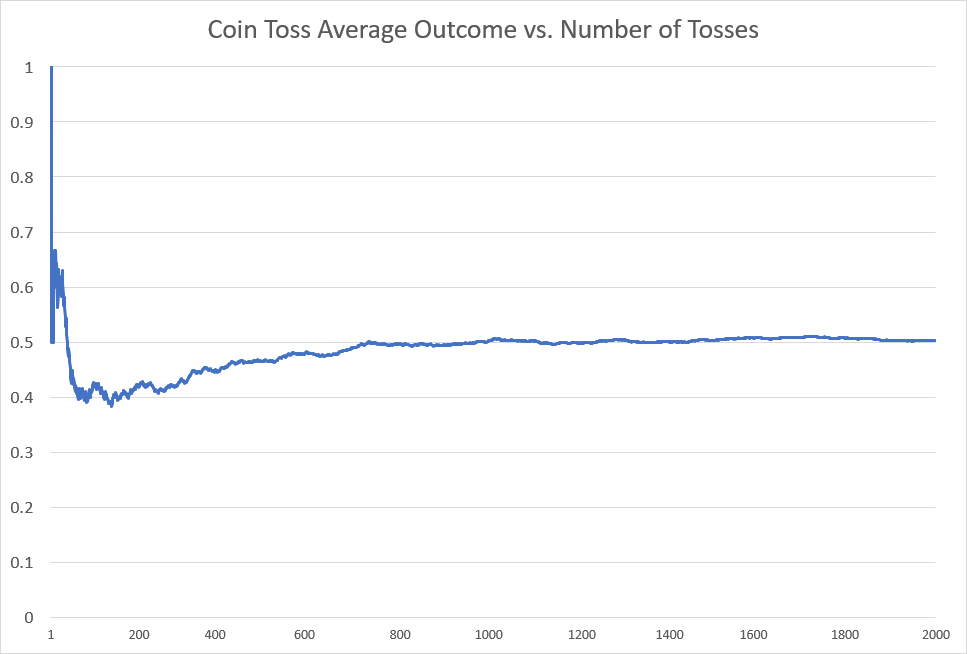
The image above shows a simulated random coin toss performed 2000 times. If we bet on heads every time, there is a chance that the coin could land on heads ten times consecutively. However, this event wouldn’t mean the probability of the coin landing on heads overall is 100%. Regardless of how we start, we will get very close to 50% probability over any random number of coin tosses over an extended period. The same analogy applies exactly to trading.
The law of large numbers underscores that trading is a very long game, based on a large sample size of trades. In that sample size, there is a random distribution of winners and losers. Trading the markets is like a continuum instead of a defined destination. Essentially, long-term gains and performance should be sought after more. The latter is very challenging to achieve consistently due to the nature of volatile markets.
Why winning percentages don’t matter much
Most traders tend to fixate on the winning percentage to assert how good a trading strategy is while ignoring that the winning percentage says nothing about the probability of a winning trade.
In essence, winning percentages don’t matter as we’ve established that 50-50 is the realistic probability ratio. A point of intrigue is that the winning percentage may show lower or higher than 50% over a large sample size, though overall, the trading account itself has gained substantially.
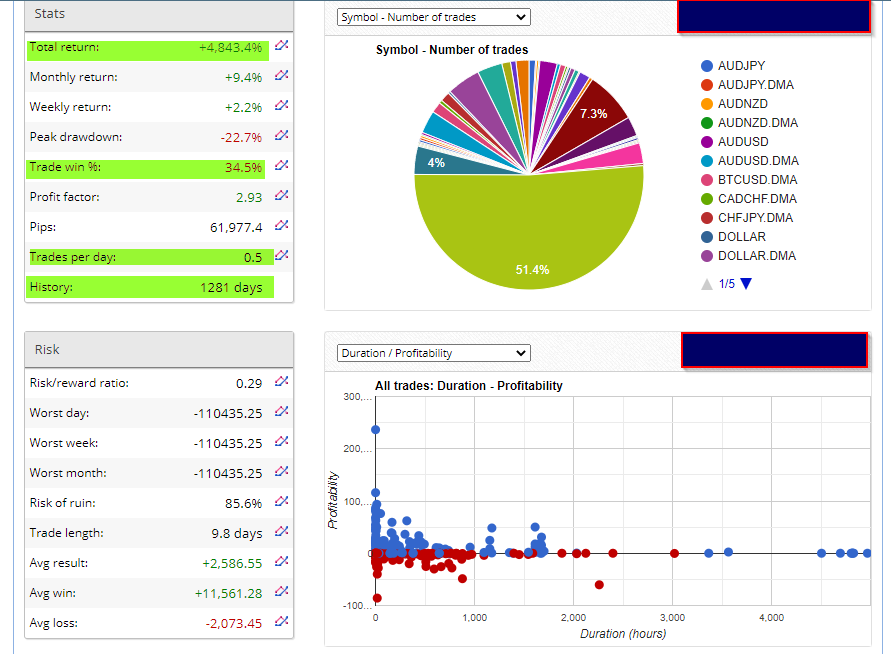
The account statement above emphasizes many of the concepts of the law of large numbers and probabilities. Firstly, we should observe that the trade win percentage is 34.5%, surprisingly lower than 50%.
So, granted, if this trader continued trading, over weeks, months, or even years, that percentage would approach 50%. Though even at 34.5%, an uneducated trader may assume that to be a low win percentage. In the long run, this account returned a whopping gain close to 5000% over approximately three and a half years (1281 days).
Another vital point to note is that the average number of trades is 0.5. If we multiply that by the number of days the account was live (1281 days), we could approximate that the trader made 640 trades over that period.
Final Thoughts
All these components in all the observed images suggest why winning percentages are irrelevant when we thoroughly comprehend probabilities as they should be.
It also stresses the importance of consistency, observing your performance over the long run, and the power of risk-to-reward.
Trading is a numbers game; over many trades, results tend to balance out (law of large numbers). Short-term wins or losses mean little. What matters is performance over a large sample size.
