




TL:DR
- Risk of ruin measures the probability of blowing up your trading account or suffering losses that are very difficult to recover from.
- Your risk of ruin is influenced by factors such as your win rate, risk-to-reward ratio, drawdown, and how much of your account you risk on each trade.
- Even profitable trading strategies can experience losing streaks, which is why strong risk management is essential for long-term survival.
- Keeping your risk per trade small (often 1-2% or less of account equity) can dramatically reduce the chance of ruining your account.
- The goal of successful trading is not to avoid losses altogether, but to manage risk in a way that allows you to survive losing periods and remain consistently profitable over time.
What if you knew a straightforward metric that quickly tells you the likelihood? Enter the risk of ruin, a statistic providing you a chance (represented as a percentage) of how likely you would blow your account based on your risk per trade, average win percentage, and average risk-to-reward (RR) ratio.
Understanding your risk of ruin is the pinnacle of mastering risk management in forex. All too often, traders who lose money think about risk too narrowly, focusing on only one or two factors.
It may seem illogical to accept, yet it's possible to lose money in the long run with an average win percentage of 50% and a risk-to-reward ratio of 1:2. Although the possibility is technically low, it remains ever-present nonetheless.
Still, even if your risk of ruin is minute, you'd probably be interested in ways of bringing it as close to zero as possible. In this article, we'll cover this concept in more detail, how to calculate it, and methods of improving it.
So, what is the risk of ruin?
The risk of ruin is expressed as a percentage, reflecting the probability that a trader will blow their account or lose a substantial portion of it. If your risk of ruin is higher than the recommended figure, you may reach a level where the possibility of recovering your losses is slim to none (known as the point of ruin).
You need to incorporate this concept with the drawdown to get the most accurate calculation that we'll explore. The drawdown measures how much your account has dipped (as a percentage) from its current level after a series of losses.
It's also another critical metric to grasp, along with the risk of ruin. According to most of the literature, an optimal drawdown is typically no more than 20%. It allows you to recover to your account's previous peak and beyond in as little time as possible.
How to best calculate your risk of ruin
Several methods for calculating your risk of ruin are available to you. Of course, you want to utilize only the simplest options without getting bogged down in complicated mathematical equations.
Let's cover two options, one simple and the other needing a bit more work. Regardless of the channel you employ, you need substantial numerical data for your strategy as a prerequisite.
This information should be available from your forward/back testing or journaling results.
Forex risk of ruin calculator
The first calculation option is to use the numerous online calculators. Here, you input a few statistics. In most cases, these include your win percentage, risk-to-reward, and risk per trade.
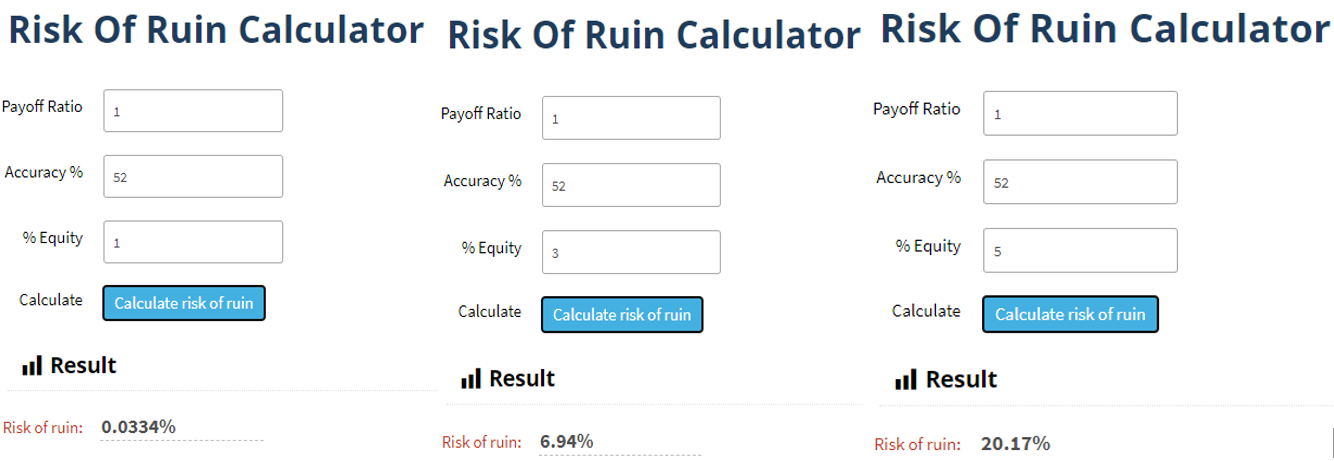
(Image showing several risk of ruin calculations)
In the image above, let's imagine three scenarios in which a trader had an RR of 1:1 (payoff ratio) and a 52% win rate. One can see how the risk of ruin percentage changes drastically as you increase the percentage of equity risked per position.
Building a risk of ruin table for forex trading
Generally, consensus on the recommended risk of ruin rate sits between 0% and 0.5%; this is what you should aim for. Anything remotely or tremendously higher is a cause for concern and impetus for traders to improve their overall money management. You can apply formulas, presented below, to create your personal advanced trading journal spreadsheet with risk of ruin calculation:
~ Using the ‘[1 - (B - P)) / (1 + (B - P)] ^U’ formula
The alternative to online calculation is to use the following formula:
[1 - (B - P)) / (1 + (B - P)] ^ U
B represents your average win percentage, P reflects your average losing percentage); ^U represents your drawdown percentage.
Let's consider an example to fully grasp this method. Imagine 'Sam' has decided on a drawdown level of 15%. He also has an average winning percentage of 65% (B), meaning their loss rate is 35% (P). We can now replace the calculation with the figures:
[1 – (0.35)] divided by (1 + (0.35) = 0.48
Note: 0.35 is 100 times less than 35 (the difference between B and P) to get a decimal representation of the whole figure.
Using 0.48, we find the 15th power, resulting in 0.000017, or 0% when rounded up. Theoretically, such statistics represent the ideal risk of ruin, assuming the strategy does not change.
Final thoughts
At its core, the risk of ruin percentage reinforces the importance of allocating a conservative portion of your equity to all positions. Your long-term survival in the markets boils down to this one concept.
The 0-0.5% threshold exhibits the minutest likelihood of blowing your account over a trading lifetime, and this is what's important. As a trader, you aim to have a lifelong, consistent strategy that will never cause you to lose a substantial portion of your account and will allow you to overcome inevitable losing streaks in the least amount of time.
No matter your level of conviction in picking the best trading opportunities, losses are still a reality. The most profitable traders realise they will lose at some point, but have the confidence never to deviate from their trading plan and strategy.
Risking 'small' or not more than 2% of your equity on any given trade is one of the primary methods for ensuring your risk of ruin is healthy. In this article, you'll hopefully have understood the importance of improving the reward of your trades as much as possible to maximize profits.
Overall, knowing your point of ruin is the foundation of money management in forex and is a statistic every serious trader should calculate beforehand.
